
Ayurveda works best when applied as a structured lifestyle system, not random remedies. Ranking habits by impact helps beginners see real results faster and more safely.
Most people searching for Wellhealth Ayurvedic Health Tips want a list of things to try. Here’s the direct answer:
The most effective Ayurvedic approach is to fix your daily rhythm first, digestion second, diet third, and herbs last.
Problem: People try herbs, detox drinks, or diets and see inconsistent results.
Agitation: Advice online is repetitive, oversimplified, and rarely explains order or context.
Solution: Follow a ranked system based on physiological impact, not popularity.
This guide is for beginners who want clarity, intermediates who want structure, and professionals who want a clean framework. It is not for people looking for miracle cures or instant results.
Table of Contents
The Ayurvedic Impact Pyramid (Your Priority Map)
| Layer | Focus | Why It Matters | Mistake People Make |
| Foundation | Rhythm | Controls hormones | Ignoring sleep timing |
| Level 2 | Digestion | Drives nutrient use | Eating randomly |
| Level 3 | Diet | Personalizes health | Copying diets |
| Top | Herbs | Fine-tuning support | Starting here |
Systems Insight: Ayurveda is hierarchical medicine. The lower layers amplify everything above them.
Layer 1 – Biological Rhythm Alignment
The fastest health improvements often come from timing adjustments, not supplements.
High-impact rules
- Sleep before ~10:30 pm
- Eat meals at fixed times
- Wake consistently
Research from institutions like the National Institutes of Health and Harvard Medical School sleep studies shows circadian disruption affects metabolism, inflammation, and cognition.
Quick Rhythm Audit Checklist
- Do you wake at the same time daily?
- Do you eat your largest meal before 3 pm?
- Do you feel alert at sunrise or groggy?
If most answers are “no,” this layer is your priority.
Layer 2 — Digestive Strength (Agni)
Ayurveda teaches:
Weak digestion creates internal imbalance before disease appears.
Modern parallels exist in gastroenterology and microbiome research from organizations like the World Gastroenterology Organisation.
Strong digestion indicators
- Hunger appears predictably
- Meals feel light after eating
- Energy stays steady
Weak digestion indicators
- Bloating or heaviness
- White tongue coating
- Energy crash after meals
Example Scenario
If someone eats a healthy meal but feels sleepy afterward, the issue is not food quality—it’s digestive efficiency.
Layer 3 — Personalized Nutrition (Not Trend Diets)
| Symptom Pattern | Likely Functional Imbalance | Adjustment Strategy |
| Restlessness + dryness | Vata | Warm cooked foods |
| Heat + irritability | Pitta | Cooling meals |
| Sluggishness + congestion | Kapha | Light, spiced foods |
Clarification: Doshas are dynamic physiological patterns, not personality types. They shift with stress, season, sleep, and age.
The World Health Organization Traditional Medicine Strategy emphasizes individualized care as a hallmark of traditional systems—Ayurveda predicted this centuries ago.
Layer 4 – Herbs & Therapies (Fine-Tuning Stage)
| Herb | Primary Use | Best Timing |
| Ashwagandha | Stress balance | Night |
| Turmeric | Inflammatory support | With meals |
| Tulsi | Respiratory support | Morning |
| Amla | Nutrient support | Empty stomach |
Critical Rule: If sleep and digestion are poor, herbs act like temporary patches.
The National Center for Complementary and Integrative Health notes that herbal efficacy often depends on overall lifestyle context.
Symptom-Based Quick Action System
| Symptom | First Fix | If Not Improved |
| Poor sleep | Sleep earlier | Reduce evening screens |
| Bloating | Eat smaller meals | Add ginger tea |
| Low energy | Earlier lunch | Walk after meals |
| Brain fog | Hydrate | Morning sunlight |
This decision-table approach prevents overwhelm and gives immediate direction.
Beginner Implementation Roadmap (5 Weeks)
| Week | Focus | Goal |
| 1 | Sleep timing | Stable wake time |
| 2 | Meal schedule | Regular digestion |
| 3 | Eating habits | No bloating |
| 4 | Food quality | Personalized diet |
| 5 | Herbs | Optional support |
Visual Trend Model — Habit Impact Over Time
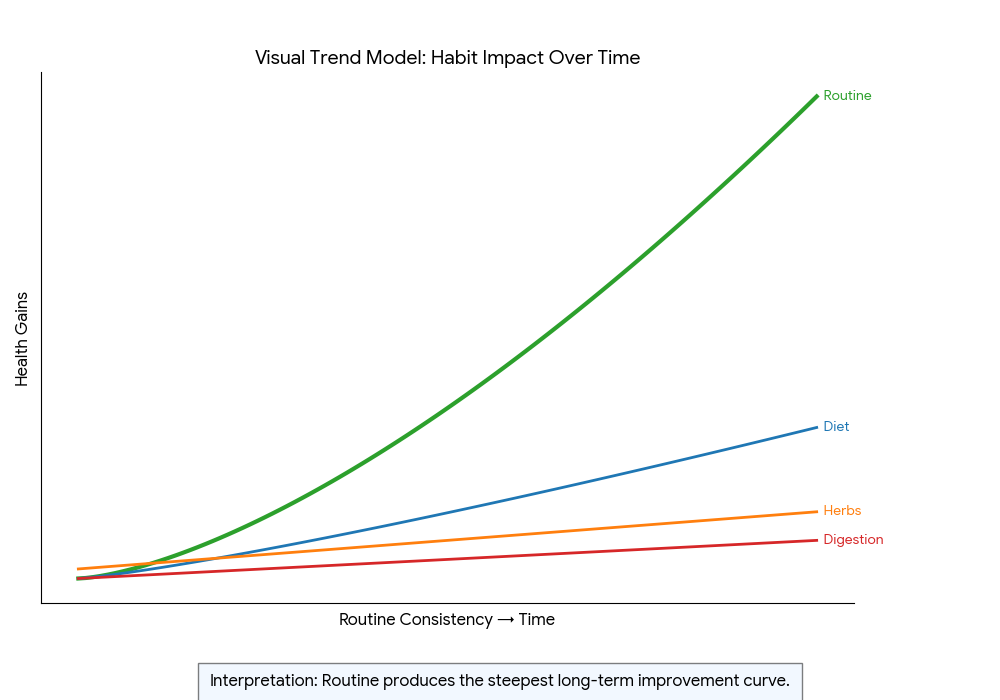
Interpretation:
Routine produces the steepest long-term improvement curve.
Intermediate Optimization Layer
Once basics work:
- Adjust meals seasonally
- Add breathing practices during stress
- Use light mono-meal days
These refinements enhance resilience but only after foundations are stable.
Common Failure Patterns
| Pattern | Why It Fails | Better Move |
| Herb stacking | Hard to track effects | Test one at a time |
| Extreme detox | Weakens metabolism | Gentle resets |
| Skipping meals | Disrupts rhythm | Eat consistently |
| Rigid diets | Causes stress | Adapt flexibly |
Measuring Progress (Objective Signals)
Track weekly:
- Morning alertness
- Digestive comfort
- Mood stability
- Sleep depth
Tip: Trends matter more than daily fluctuations.
Safety & Responsible Practice
Consult a qualified practitioner before major changes if you:
- Take medication
- Are pregnant
- Have chronic conditions
Regulation varies:
- US supplements regulated as foods (FDA framework)
- EU herbal products reviewed under EMA traditional herbal directives
Natural does not automatically mean safe.
Who This System Is Best For
Ideal readers
- Beginners who want structured guidance
- Busy people needing high-ROI habits
- Health learners seeking logic behind tradition
Not ideal for
- People expecting instant results
- Those unwilling to change daily routine
Conclusion – The Core Principle
Most advice about Ayurvedic health tips is fragmented. Real Ayurveda is integrated.
Fix rhythm.
Strengthen digestion.
Personalize diet.
Add herbs last.
Follow that sequence and Ayurveda stops being confusing wellness content—and becomes a practical health system.