
Buffalo milk is one of the most nutrient-dense dairy options, but its high fat and calorie load mean it is ideal for some people and less suitable for others. This guide provides a data-driven framework to decide when buffalo milk is truly beneficial.
Problem: Many articles claim buffalo milk is simply “healthier” than regular milk.
Agitation: That oversimplification leads people to drink it in the wrong situations especially during weight loss or heart-conscious diets.
Direct Answer: Buffalo milk does offer higher protein, calcium, and energy than cow milk, but its benefits depend heavily on your goals, digestion, and calorie needs.
If you need involved nutrition for growth, muscle gain, recovery, buffalo milk can be superb. If you need calorie control, moderation matters.
Table of Contents
What is WellHealthOrganic?
WellHealthOrganic is mostly presented online as a health-focused organic dairy brand or content platform that promotes natural, chemical-free, and properly food products. Its placing centers on three core ideas health, wellness, and organic living sustainable farming, humane animal care, and minimally processed dairy. Many articles associated with the brand highlight organic feed, animals, and eco-friendly production methods as key differentiators in the dairy industry.
What did Wellhealthorganic say About Buffalo Milk?
Content attributed to WellHealthOrganic consistently describes buffalo milk as a nutrient-dense dairy option with higher fat, protein, calcium, and minerals than typical cow’s milk, contributing to its richer texture and higher energy value. The brand-style messaging also stresses organic locating, grass-fed buffalo, and the lack of antibiotics or GMOs to position the milk as both healthier and more ethically produced. In addition, buffalo milk is promoted for bone strength, muscle support, and creamy culinary applications such as yogurt, paneer, and cheese.
Who This Guide Is For (and Not For)
Best for:
- Beginners comparing milk types
- Fitness and nutrition learners
- Parents choosing milk for children
- Underweight individuals seeking healthy calories
Less relevant for:
- Strict calorie-cutting diets
- People avoiding dairy entirely
- Individuals with diagnosed milk allergies
Buffalo Milk vs Cow Milk — Key Differences
Most confusion comes from comparing the two milks superficially. The real difference is nutrient density per glass.
Qualitative Comparison (per ~100 ml)
| Factor | Buffalo Milk | Cow Milk | Practical Meaning |
| Fat | Much higher | Lower | More calories and satiety |
| Protein | Higher | Moderate | Better for muscle repair |
| Calcium | Higher | Good | Strong bone support |
| Calories | Higher | Lower | Not ideal for calorie deficits |
| Texture | Thick, creamy | Light | Feels heavier in stomach |
| Digestibility | Slower | Easier | Sensitive users may notice |
Evidence context: Nutrient patterns align with benchmarks reported by the Indian Council of Agricultural Research (ICAR) and standard dairy composition tables.
POV insight: Buffalo milk is not “better milk.” It is higher-density milk—a crucial distinction.
Nutritional Profile of Buffalo Milk
(Typical values; vary by breed, feed, and processing)
| Nutrient | Typical Range | Why It Matters |
| Energy | ~95–110 kcal | High energy density |
| Protein | ~3.8–4.5 g | Tissue repair |
| Fat | ~6.5–8 g | Satiety and calories |
| Calcium | ~180–210 mg | Bone strength |
| Phosphorus | High | Works with calcium |
| Vitamin A | Present | Vision & immunity |
Authoritative references where such values typically appear:
- Indian Council of Agricultural Research (ICAR)
- Food and Agriculture Organization (FAO) dairy data
- USDA FoodData Central
Major Health Benefits of Buffalo Milk
Stronger Bones and Teeth
Buffalo milk is naturally rich in calcium and phosphorus—two minerals essential for bone mineral density.
Who benefits most
- Growing children
- Teenagers
- Older adults with low calcium intake
- Pregnant or breastfeeding women (with medical guidance)
Reality check: If your diet already meets calcium needs, the extra benefit may be marginal.
Supports Muscle Growth and Recovery
Because buffalo milk contains more protein per glass, it can support:
- Post-workout recovery
- Muscle maintenance
- Strength training nutrition
Example scenario
A beginner gym-goer needing ~20 g protein after training could get a meaningful portion from a large serving of buffalo milk plus another protein source.
Why this matters: Higher protein density improves convenience—not magic muscle gain.
Effective for Healthy Weight Gain
This is where buffalo milk clearly shines.
Best use cases
- Underweight adults
- Teens with high metabolism
- People recovering from illness
- Individuals with high daily energy expenditure
Failure pattern to avoid
Many sedentary adults switch to buffalo milk thinking it is universally healthier—then unintentionally increase daily calories.
POV takeaway: Buffalo milk is a tool for energy surplus, not a default daily upgrade for everyone.
Longer Satiety and Energy Support
Higher fat slows stomach emptying, which may:
- Reduce frequent hunger
- Provide sustained morning energy
- Support people who struggle with constant snacking
Real-world example
- Office worker skipping breakfast → hunger by 10 AM
- Same person drinks buffalo milk → improved fullness window
(Individual results vary.)
Who Should Drink Buffalo Milk (and Who Should Avoid It)
Ideal Candidates
- Growing children and teenagers
- Athletes and gym users
- Underweight individuals
- People with physically demanding jobs
- Those needing calorie-dense nutrition
Use With Caution
- Weight-loss diets
- People with elevated LDL cholesterol
- Sedentary adults with low calorie needs
- Individuals with lactose intolerance
- People advised to follow low-fat diets
Medical note: If you have cardiovascular risk factors, consult a qualified professional. Organizations like the World Health Organization (WHO) and American Heart Association emphasize monitoring saturated fat intake.
Recommended Daily Intake and Best Time to Drink
Practical Intake Guide
| User Type | Suggested Approach |
| Children | ~1 glass daily |
| Active adults | 1–2 glasses |
| Weight loss | Small portions or diluted |
| Seniors | Moderate, monitor digestion |
(Illustrative guidance — individual needs vary.)
Best Time to Drink: Myth vs Reality
Morning
- Good for sustained energy
- Helpful for people with early hunger
Post-workout
- Supports recovery
- Convenient protein source
Night
- May promote fullness
- Can feel heavy for some people
Bottom line: Timing matters less than total daily intake.
Products, Prices, and Reviews Worldwide
| Brand/Product | Country | Price Range* | Notable Feature | User Feedback |
| Amul Buffalo Milk | India | Mid-range | Wide availability | Consistent quality |
| Aavin Buffalo Milk | India | Budget–mid | Fresh supply chains | Popular regionally |
| Mediterranean Buffalo Milk | Italy | Premium | Used in mozzarella | High richness |
| Local Farm Buffalo Milk | Global | Varies | Fresh/raw options | Quality varies |
*Prices vary by city and packaging.
Geo nuance:
South Asia (especially India and Pakistan) dominates buffalo milk consumption, while Europe uses it more for specialty cheeses like mozzarella.
Graph – Nutrient Density Comparison

Interpretation: Buffalo milk consistently delivers more nutrients per equal volume, which explains both its advantages and its calorie trade-off.
Pie Chart — Global Buffalo Milk Consumption Share
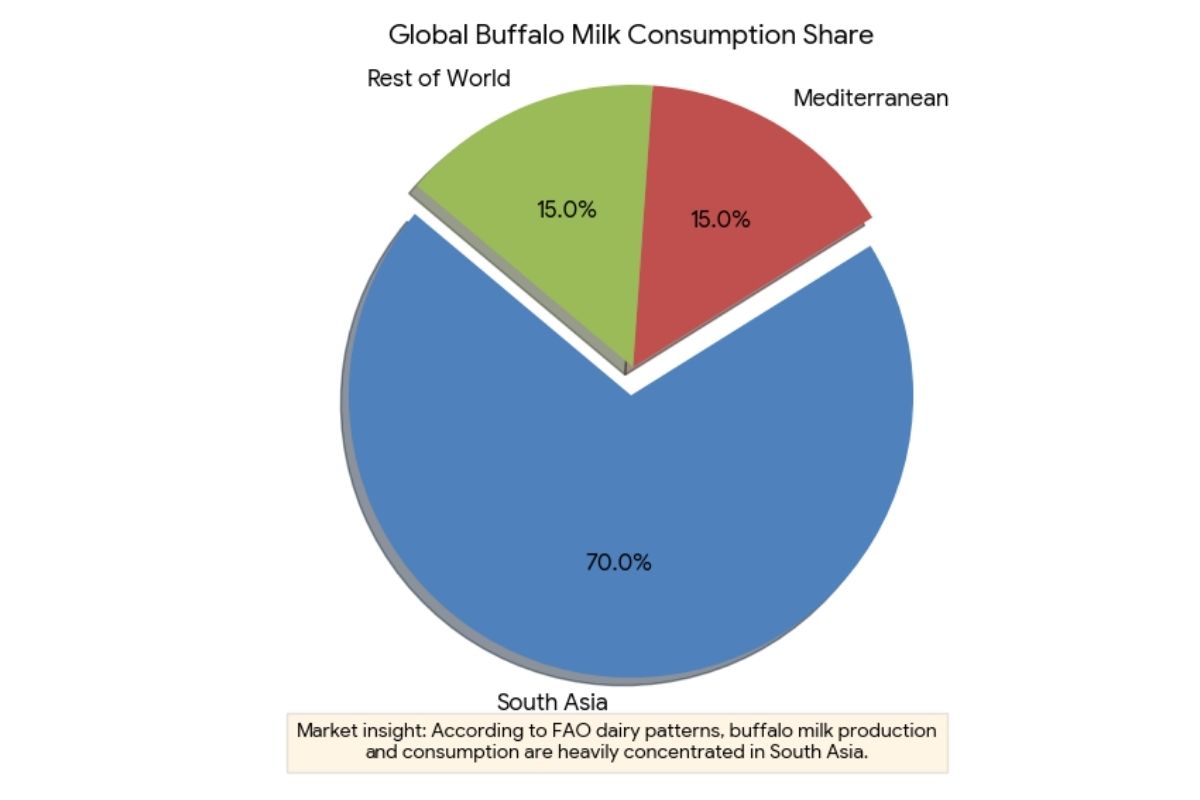
Market insight: According to Food and Agriculture Organization (FAO) dairy patterns, buffalo milk production and consumption are heavily concentrated in South Asia.
Decision Framework: Is Buffalo Milk Right for You?
Choose buffalo milk if you:
- Need healthy weight gain
- Train regularly
- Have high calorie needs
- Want thicker, more filling milk
Limit or reconsider if you:
- Are actively losing weight
- Have been advised to reduce saturated fat
- Experience digestive heaviness
- Have lactose intolerance symptoms
Conclusion
Buffalo milk is a powerful, nutrient-dense dairy choice but it is not universally superior. It contains higher protein, fat, and calcium content make it especially valuable for children, athletes, and weight gaining. For calorie-restricted diets or certain heart-health goals, moderation becomes critical.
Simple rule to remember: Choose buffalo milk when you need more nutrition per glass—not simply because it sounds healthier.
FAQs
Is buffalo milk good to drink daily?
Yes, in moderate amounts that fit your calorie needs and digestion tolerance.
Is buffalo milk good for weight loss?
Usually not ideal due to higher calories unless portion controlled.
Is buffalo milk harder to digest than cow milk?
Some people find it heavier because of higher fat content.
Can children drink buffalo milk?
Yes. It can support growth, but portions should be age appropriate.
Which milk is better for gym users?
Buffalo milk often provides an advantage due to higher protein and calories.